
The Caregiver's Uncertainty
The Reason I JumpThis flow traces how David Mitchell's uncertainty about his autistic son is changed by encountering Naoki Higashida's first-person account.
increasing Bearing strength in each event
 decreasing
Bearing strength in each eventdecreasingA Parent Searching for Answers
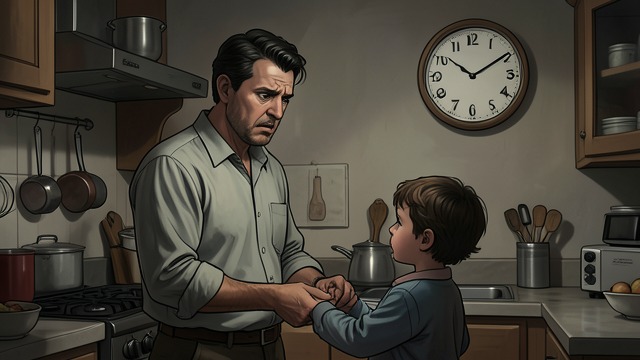
A Parent Searching for Answers
Distress at home
David Mitchell recalls the difficulties of caring for his young autistic son, including behavior he could not explain. Existing theories and descriptions did not provide the specific understanding he needed.
A gap in knowledge
The problem was not lack of concern but lack of access to his son's inner experience. That gap left the family looking for a way to understand what outward behavior could not say.
Books That Do Not Reach the Kitchen

Books That Do Not Reach the Kitchen
Competing explanations
Mitchell describes support manuals, academic texts, and parental memoirs as useful in some ways but often distant from the family's immediate problems. General theories could not reliably explain one particular child.
A need for first-person knowledge
He wanted to know why his son was distressed and how the child experienced ordinary events. The search was for a voice that could bridge theory and the family's daily life.
Finding Naoki's Book

Finding Naoki's Book
A new kind of answer
Mitchell's wife receives The Reason I Jump, written by Naoki Higashida as a teenager. Naoki's explanations seem to speak directly to problems they had been trying to understand.
Recognition through another voice
The book feels to Mitchell like a way for his own son to be heard through someone else's words. That connection restores the possibility that a child who cannot speak still has a complex account of his world.
Faith in the Son

Faith in the Son
Revising assumptions
Mitchell says that Naoki's book made it harder to believe that autistic people lack curiosity or empathy. It encouraged him to trust that his son was attentive to the world even when he could not show it conventionally.
A changed relationship
Greater patience and more ambitious expectations became possible. The knowledge did not make caregiving effortless, but it helped Mitchell respond with more confidence and understanding.
Sharing the Discovery

Sharing the Discovery
Translation as care
Mitchell and his wife first consider an informal translation for their son's carers and friends. They then learn that other Japanese families living abroad also want the book in English.
Connection widened
The translation becomes a means of sharing a perspective that had helped one family. Mitchell's role is not to replace Naoki's voice, but to carry it to readers who need to hear it.
when Mitchell's son is very young
during Mitchell's search for autism guidance
when Mitchell's wife receives the Japanese book
after reading Naoki's explanations
after the family recognizes the book's wider value
